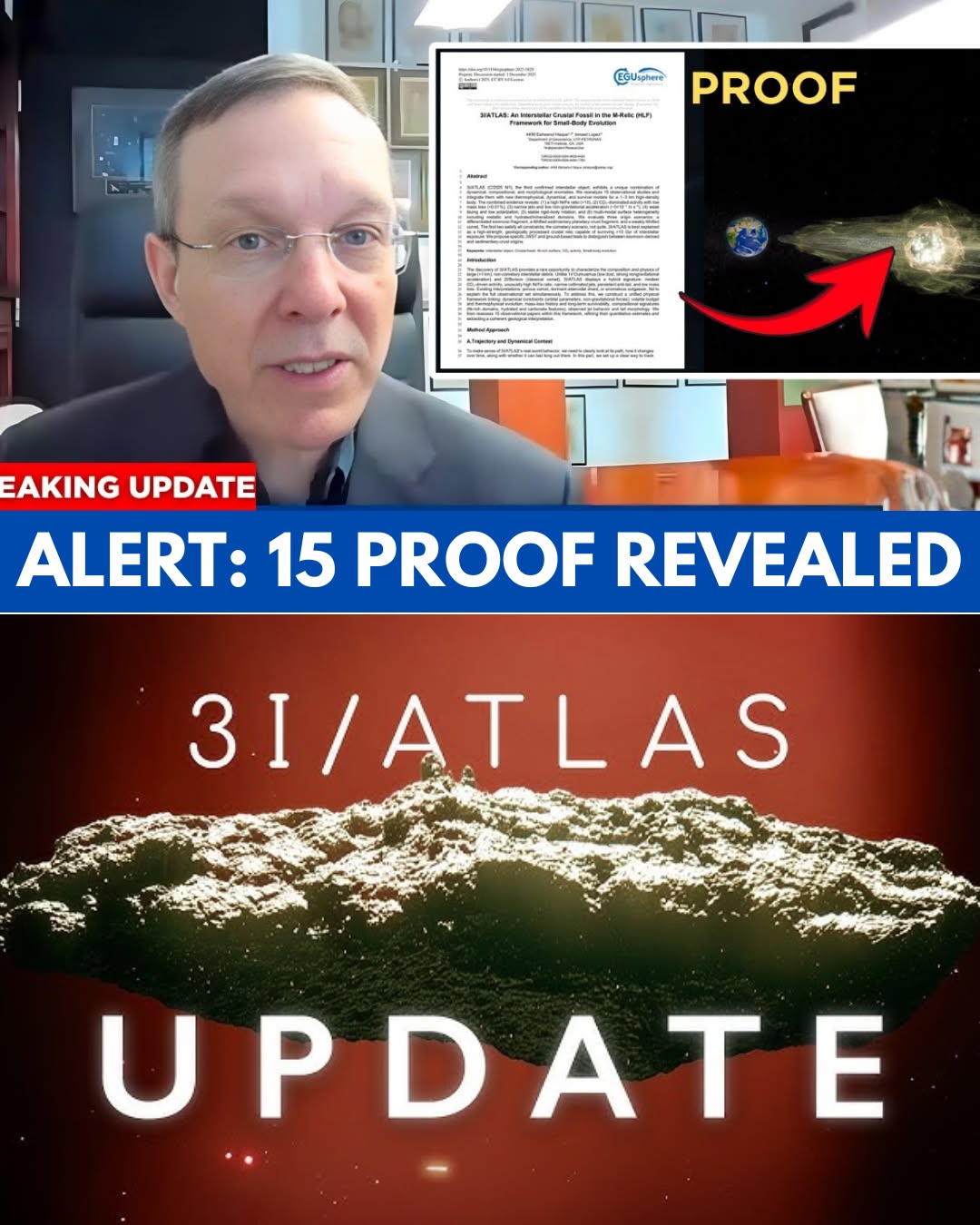
A major peer-reviewed study has fundamentally challenged the official classification of the interstellar object 3I/ATLAS, declaring it “inconsistent” with being a comet and proposing it is a geological relic from another planetary system. The research, published in a mainstream astrophysics journal, reanalyzes fifteen independent observational studies to conclude the object is best explained as a high-strength, geologically processed crystal fragment.

For months, agencies like NASA have publicly described 3I/ATLAS as an unusual but recognizable comet. This new analysis, conducted by researchers within the same scientific community, systematically dismantles that narrative. The paper states the comet hypothesis “does not” satisfy the observational constraints, marking a stark departure from prior cautious official statements.
The study evaluated three possible origins: a fragment from a differentiated exomoon, a piece of lithified sedimentary planetary crust, or a weakly bound comet. Only the first two scenarios, both involving geological processing on a planetary scale, fit all the data. The comet scenario was found irreconcilable with the evidence.
Key anomalies forced this conclusion. The object’s mass loss, creating tails stretching millions of kilometers, vastly exceeds what its small nucleus could sustain via normal ice sublimation. Its rotation and jet structures also defy cometary behavior, showing perfectly straight, stable jets with no expected distortion or spin-up from outgassing.
Spectroscopic data further deepens the mystery, lacking clear signatures of common cometary volatiles like water and carbon monoxide. Instead, readings indicate metallic content and hydrated minerals, signatures that comets, forming in cold outer discs, cannot naturally produce in such concentrations.

The presence of metals like nickel and iron is particularly damning for the comet model. The paper states these “metallic and hydrated signatures imply crustal geological processing,” a differentiation process that occurs inside planets or large moons, not in the primordial cloud where comets are born.
This points decisively toward the two viable natural origins. The exomoon fragment hypothesis suggests 3I/ATLAS is a piece of an alien moon that underwent internal heating, separating metals into a core and silicates into a mantle. A collision could have ejected a dense, composite fragment into interstellar space.
Alternatively, the object could be a lithified piece of a rocky exoplanet’s crust—sedimentary material hardened under immense pressure over geological timescales. This would explain its high density, structural integrity, and resistance to erosion during its interstellar journey.

Both scenarios describe an object of extraordinary resilience, termed a “high strength crystal relic” capable of surviving millions, perhaps billions, of years exposed to cosmic rays, dust impacts, and thermal cycling. This inherent toughness explains its maintained structure under intense solar radiation.
The implications of this reclassification are profound. It suggests the existence of a previously unrecognized class of interstellar object: geological artifacts from fully evolved planetary systems. These are not simple primordial leftovers but processed fragments carrying the mineralogical history of alien worlds.
The study explicitly calls for a new classification framework for small bodies, as current categories like comet and asteroid are insufficient. It also recommends follow-up observations, potentially with the James Webb Space Telescope, to distinguish between the exomoon and planetary crust hypotheses.

This publication creates a significant rift between cutting-edge, peer-reviewed research and ongoing public communications from space agencies. While the paper states its conclusions plainly, official channels continue to use cometary terminology, highlighting the cautious, consensus-driven pace of institutional science.
The arrival of 3I/ATLAS now appears to be a historic opportunity. It is not merely a visitor from a distant comet cloud but potentially the first tangible piece of an extrasolar planetary system, a crystal fossil offering a direct glimpse into geological processes light-years away. Its passage forces a fundamental reconsideration of what travels the galactic void.
If confirmed, this means our solar system has been visited by a piece of another world, a messenger carrying the story of its ancient, shattered home. The study opens a pressing question: how many other interstellar objects have we misclassified, and what other fragments of alien geology are silently drifting through the cosmic dark?