Something about 3I/ATLAS simply doesn’t make sense — and that’s exactly why it has scientists paying very close attention.
Discovered racing through the inner solar system, 3I/ATLAS initially appeared to be just another fast-moving interstellar object. But as more data came in, researchers began to notice a growing list of anomalies that defy conventional explanations. Now, some of the world’s leading astronomers are openly admitting: the numbers don’t add up.

Harvard astrophysicist Avi Loeb recently analyzed the object’s motion using standard physical laws. According to momentum conservation, an object accelerating at ATLAS’s observed rate — especially during its close pass near the Sun — should be shedding enormous amounts of mass. The calculations suggest roughly 5.5 billion tons of material should have been expelled.
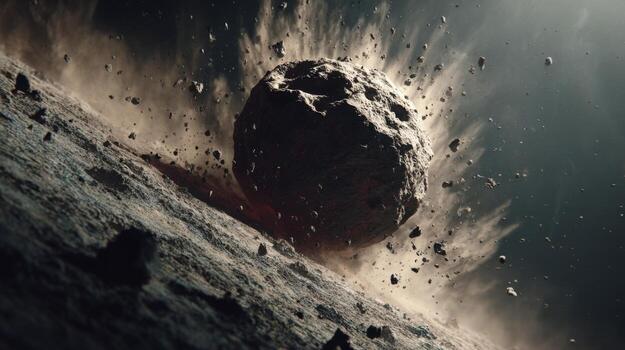
Yet telescopes see nothing.
No visible gas plume.
No dust tail.
No debris cloud.
For a natural comet or asteroid, such acceleration without mass loss is essentially impossible. “If this were a normal object,” Loeb explains, “the evidence should be unmistakable. But it simply isn’t there.”
Adding to the mystery, the Atacama Large Millimeter/submillimeter Array (ALMA) in Chile detected something even more troubling: 3I/ATLAS has drifted approximately 4 arcseconds off its predicted trajectory. That deviation may sound small, but in astronomical terms, it is significant — and cannot be explained by gravity alone.

Even more puzzling is the object’s distinct blue coloration, which does not match typical cometary compositions. Blue signatures usually indicate highly unusual surface or reflective properties, raising questions about the object’s structure and origin.
Taken together, these observations suggest that 3I/ATLAS may not behave like any known natural body. Some researchers propose exotic explanations such as unknown physical processes or extreme material properties. Others — more controversially — argue the object may represent something far more extraordinary.
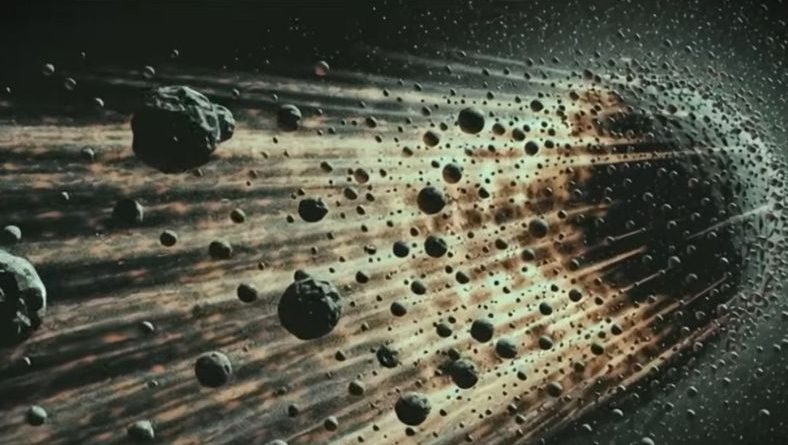
On December 19, 2025, 3I/ATLAS will make its closest approach to Earth. This moment will offer astronomers their best opportunity yet to resolve the mystery. Powerful ground-based and space telescopes will be trained on the object, searching for any sign of the “missing mass” that physics demands should exist.
If that mass still cannot be found, the implications could be profound.
While no one is claiming definitive proof of extraterrestrial technology, scientists are increasingly willing to ask uncomfortable questions. As Loeb has noted before, dismissing anomalies simply because they challenge existing theories is not science — it’s avoidance.
For now, 3I/ATLAS remains an enigma speeding through our cosmic neighborhood. And in just a matter of months, humanity may learn whether this strange visitor is merely an unsolved natural phenomenon… or something that forces us to rethink our place in the universe.