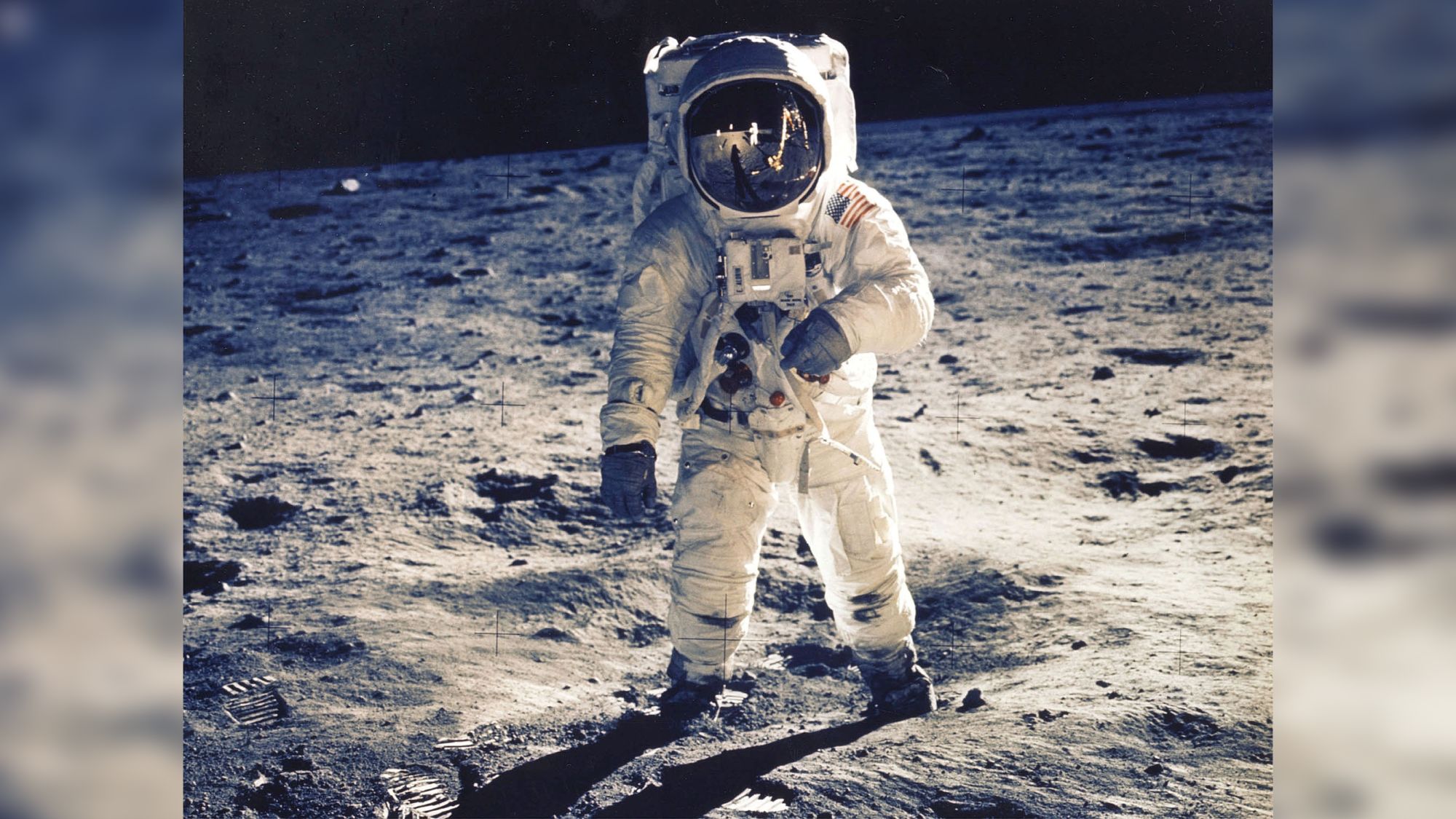
Buzz Aldrin, the second man to walk on the Moon, has always been a symbol of human exploration and achievement.
Yet behind the medals, parades, and global admiration lies a story few truly understand—a story of awe, isolation, and a haunting realization that changed him forever.
In recent years, Aldrin has spoken cryptically about his experiences on the Moon, hinting at observations that went far beyond the scientific experiments and triumphant first steps recorded in history.
His words, “The Moon is not what you think,” have left scientists, historians, and the public pondering what the Apollo 11 astronaut really saw.
On July 16, 1969, the world watched as the Saturn V rocket roared to life at Kennedy Space Center, carrying Neil Armstrong, Michael Collins, and Buzz Aldrin on a mission that promised to push the boundaries of human achievement.
Apollo 11 was not a gamble built on hope alone—it was the culmination of years of planning, testing, and preparation.
More than 400,000 engineers, scientists, and technicians worked meticulously to ensure that every bolt, every control switch, and every system would function perfectly.
Failure was not an option.

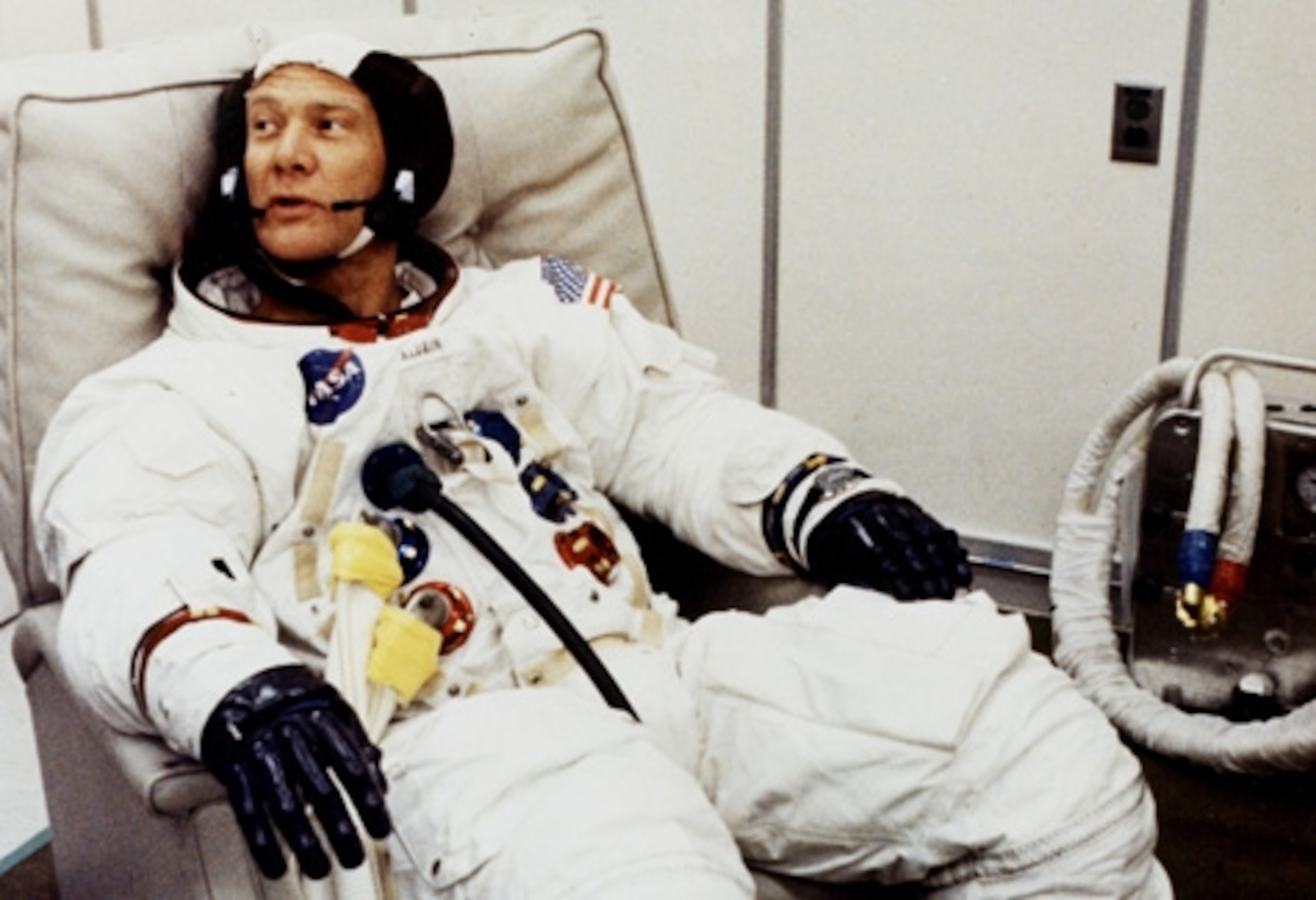
Inside the command module, the astronauts were strapped into narrow seats, enveloped by a forest of wires, dials, and switches.
The launch itself was violent, the vibrations shaking their bodies, the sound of the engines nearly deafening.
Yet amid the chaos, Aldrin’s training kept him focused.
He would later describe the launch as a transition from one world to another—a violent break from Earth’s gravity into the quiet void of space.
Over the next three days, the crew traveled toward the Moon, watching as Earth receded into the distance, a fragile blue sphere hanging against the blackness of space.
When Apollo 11 entered lunar orbit, the astronauts faced the mission’s most critical and perilous phase: landing.

For several minutes, as the spacecraft passed over the Moon’s far side, all contact with Earth vanished.
In those moments, Armstrong, Aldrin, and Collins were completely alone, suspended above an alien landscape, with no one to intervene if something went wrong.
Inside the module, silence descended.
Even the constant chatter that usually filled the cabin gave way to tense contemplation.
This was a distance from human life unlike anything previously experienced.
The landing itself was perilous.
As Armstrong guided the Lunar Module, Eagle, toward the surface, computer alarms signaled unexpected issues.
Fuel was critically low.
Every second counted.
Aldrin called out altitude and velocity readings with meticulous precision while Armstrong maneuvered manually, finding a landing spot in the gray lunar dust with less than half a minute of fuel to spare.
When Armstrong finally declared, “Houston, Tranquility Base here.
The Eagle has landed,” jubilation erupted on Earth.
But inside the module, the astronauts were silent, overwhelmed by the stillness and alien vastness stretching beneath them.
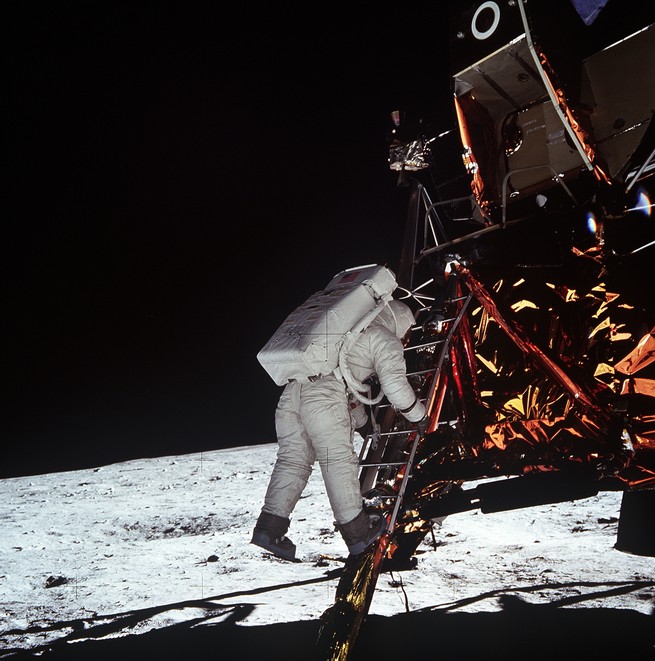
Stepping onto the Moon, Aldrin was struck not by beauty, but by emptiness.

The lunar surface was gray, flat, and lifeless, covered in fine dust that clung to his suit and boots.
Shadows were sharp, unsoftened by any atmosphere, and the horizon appeared unnaturally close, as if he were standing inside a bowl.
Every sound seemed amplified yet hollow through the radio, reinforcing a sense of isolation that weighed heavily on him.
In that moment, Aldrin described the Moon as a “magnificent desolation”—a phrase that captured both the awe and the unsettling emptiness of the lunar surface.
Amid this desolation, Aldrin performed a quiet, personal ritual.

Before joining Armstrong outside the module, he used a small communion kit to give thanks in a brief religious ceremony.
Though overlooked at the time, it was the first known religious act conducted on another world, a reflection of his desire to ground humanity and spirituality in the midst of unprecedented achievement.
Yet what Aldrin later revealed, albeit sparingly, hints at experiences that were beyond scientific documentation.
He spoke of seeing lights moving independently in the lunar sky, phenomena that did not correspond to stars, spacecraft, or any known celestial body.
He avoided reporting them in real time, understanding that the world might not comprehend or believe such a claim.
In the decades since, he has said that what he observed during those moments—on the surface and outside the module—profoundly changed him.
Returning to Earth did not erase these impressions.
Parades, medals, and speeches filled his schedule, but nothing could dispel the quiet, overwhelming scale of the Moon that had imprinted itself on his mind.
Colleagues and friends noticed a subtle change in him.

Aldrin became more introspective, often pausing mid-conversation as if lost in thought.
Even when discussing the mission publicly, his voice would occasionally tremble, his eyes fill with tears.
The silence and the scale of what he had witnessed weighed on him in ways that fame and accolades could not.
Science, in many ways, has begun to validate the sense of strangeness Aldrin felt.
Re-examination of data from Apollo-era seismometers revealed that the Moon “rang like a bell” after meteoroid impacts, suggesting an internal structure far different from Earth’s solid crust.
Isotope analyses confirmed that lunar material originated from Earth itself, likely formed from a cataclysmic collision billions of years ago.
Radar studies of the far side revealed buried masses of metal, and evidence of a once-active molten core emerged from magnetic readings.
These findings collectively challenge the perception of the Moon as a silent, inert rock, revealing a dynamic world with its own history and hidden energy.
Aldrin’s intuition about the Moon seems almost prescient.
When he whispered, “The Moon is not what you think,” he was not being cryptic for effect.
He was describing a truth that only decades later science would begin to uncover: the Moon is alive with history, intimately connected to Earth, and more complex than any human had imagined.
Every footprint he left on its surface felt like a disturbance in a world that had remained unchanged for billions of years, and the realization of this fragile, interconnected system left an emotional imprint he could not shake.
The psychological impact on Aldrin and other astronauts has informed how NASA approaches space travel today.
Long-duration missions require attention not only to physical survival but to mental well-being.
Aldrin’s experience underscores the need for support in facing the profound emotional and existential challenges of space exploration.
His reflections have influenced training, mission planning, and even the philosophical framing of humanity’s place in the cosmos.
Beyond science and exploration, Aldrin has used his voice to inspire and educate.
He advocates for international cooperation in space, emphasizing that the Moon should belong to humanity as a whole.
In classrooms and lectures, he shares lessons from the Apollo missions, not just as technical achievements, but as experiences that illuminate the human condition.
“Magnificent desolation” has become more than a phrase; it encapsulates the beauty, the isolation, and the responsibility of human exploration.
The Moon, through Aldrin’s eyes, is both a mirror and a teacher.
From its surface, he saw Earth as a fragile, luminous orb—a reminder of the planet’s beauty and vulnerability.
The Moon’s far side, with its craters, mountains, and silent plains, represents the unknown, challenging humanity to confront not just scientific mysteries but the deeper truths of existence.
Aldrin’s haunting experience reflects a larger truth: exploration is not simply about reaching new worlds, but about understanding ourselves in relation to the universe.
Decades after Apollo 11, as satellites, AI, and advanced instruments probe the lunar surface, the Moon continues to reveal secrets Aldrin intuited long ago.
Its interior complexity, its shared origin with Earth, and its potential for scientific discovery show that what he experienced was not imagination or exaggeration.
The Moon is alive in its own way, a dynamic extension of our planet, and standing on it changes a person forever.
Buzz Aldrin’s journey illustrates the emotional and philosophical weight of space exploration.
The Moon is not merely a destination; it is a confrontation with scale, silence, and permanence.
His life reminds us that achieving the extraordinary comes with personal cost, that the void beyond our world is as much a test of the soul as it is of skill and courage.
The phrase, “The Moon is not what you think,” is a testament to this understanding—a warning, a revelation, and a call to recognize our connection to the universe.
Aldrin’s legacy goes beyond the first steps and the photographs.
It lies in the profound perspective he offers, the recognition of humanity’s smallness, and the enduring wonder that compels us to explore.
As new generations prepare to return to the Moon, his experience serves as a reminder that exploration is as much about inner discovery as it is about scientific achievement.
The Moon is a teacher, a mirror, and a keeper of secrets, and for Buzz Aldrin, it will always be a part of him, silently shaping his understanding of life, humanity, and the cosmos.