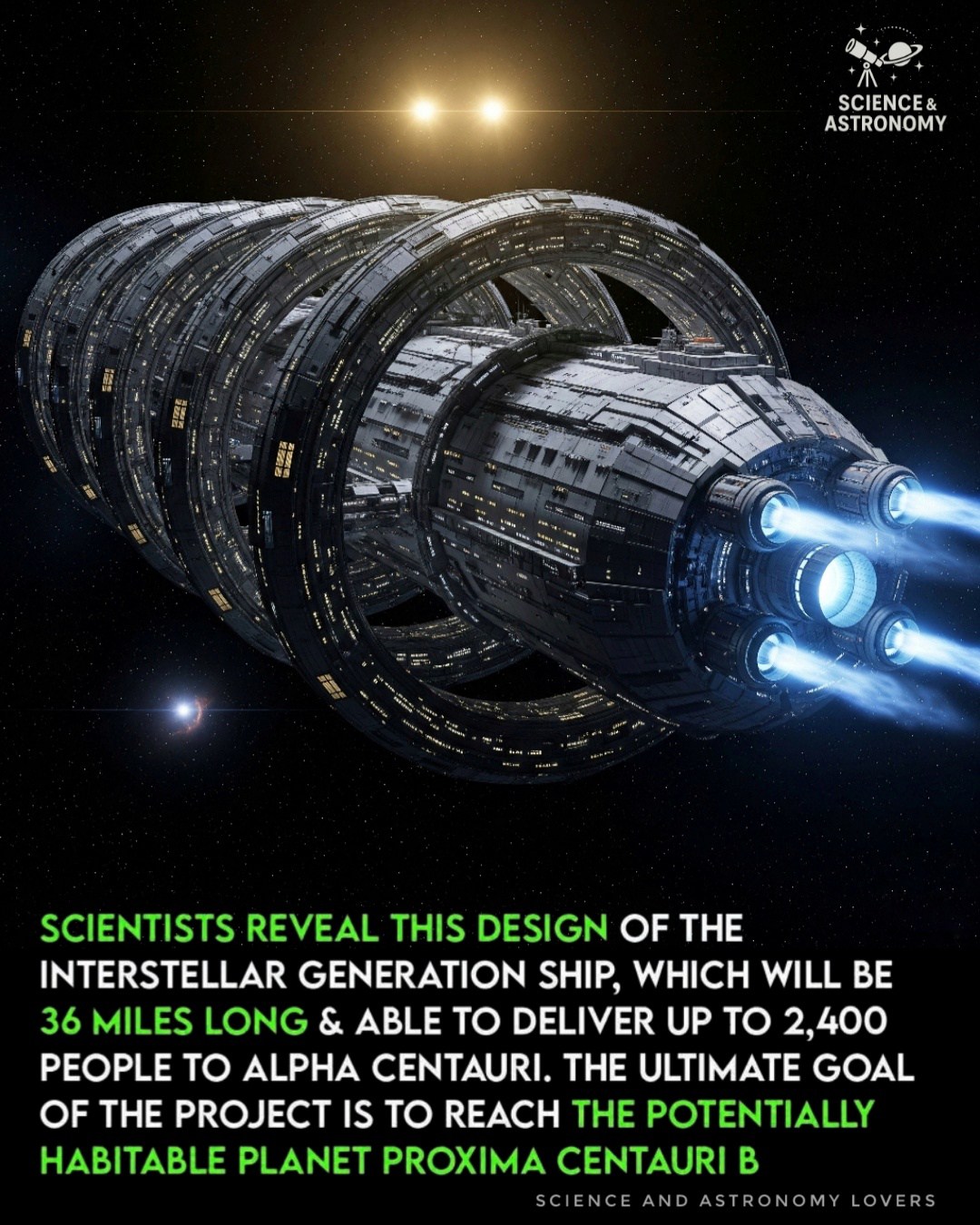
In an ambitious vision for humanity’s future beyond Earth, scientists and engineers have proposed the Chrysalis generation ship, a colossal interstellar spacecraft designed to carry thousands of people on a multi-generational journey to Proxima Centauri b, a potentially habitable exoplanet 4.24 light-years away. The concept was developed by a team of engineers participating in the Project Hyperion Design Competition, organized by the Initiative for Interstellar Studies (i4is), and won first place for its innovative approach to addressing the challenges of interstellar colonization.
Chrysalis would measure approximately 36 miles (58 km) in length, shaped like a giant cigar with a layered “Russian doll” design. The outer shells are engineered to withstand cosmic radiation, micrometeoroid impacts, and extreme temperature fluctuations. Inside, multiple concentric layers provide living spaces, agricultural zones, freshwater lakes, and green biomes, creating a self-sustaining habitat that mimics Earth’s environment.

The ship is designed to support 1,500–2,400 people, including scientists, engineers, farmers, medical staff, and educators. Rotating rings along the ship generate artificial gravity via centrifugal force, mitigating the health risks of long-term weightlessness. Advanced closed-loop life-support systems recycle air, water, and food, while onboard biomes include tropical forests, boreal woodlands, and agricultural zones to supply nutrition and maintain psychological well-being.
Chrysalis would rely on a direct fusion propulsion system, a theoretical technology that could provide both thrust and onboard energy for life-support, agriculture, and industrial systems. The voyage is projected to last approximately 400 years, meaning multiple human generations would live, work, and die aboard the ship before reaching Proxima Centauri b. This long-term isolation necessitates robust social structures, education systems, and AI-assisted governance to maintain order, preserve knowledge, and foster cultural continuity.

The designers have considered not just technology but also the ethical and psychological dimensions of such a mission. Questions of autonomy, motivation, and purpose are central: how can generations born onboard remain committed to a mission they will never personally complete? How can communities maintain cohesion, morale, and cultural identity over centuries in deep space? Chrysalis proposes extensive social planning, governance models resembling sociocracy, and AI-managed education to address these issues.

Beyond its human-focused systems, Chrysalis integrates redundant safety and maintenance mechanisms, including robotic repair systems, emergency shelters, and radiation shielding. The ship’s outer shell design distributes impacts from cosmic debris, while internal compartments are modular to allow repairs without disrupting life-support.

Proxima Centauri b, while still unconfirmed as habitable, is a prime target for interstellar colonization due to its location in the habitable zone of our nearest star. Chrysalis represents a conceptual framework for how humanity might survive and thrive beyond the solar system, combining engineering ingenuity, social foresight, and ecological sustainability.

If realized, Chrysalis would mark humanity’s first true interstellar colony, offering a blueprint for long-duration space habitation, intergenerational mission planning, and the expansion of life beyond Earth. It stands as both a scientific vision and a cultural milestone, challenging humanity to think in centuries, not decades.